One of the blessings of being a digital humanist is being able to study something as inherently interesting as music. A while ago, I had fun trying to figure out which band was the most important in the Italian music scene. That was cool, but it left open a question, which I want to address today: are the patterns that I’m seeing specific to Italian music, or do they hold in another country?
To answer this question I needed to collect data about at least another country. Lisandro Marco Benetti and Daniel Fejerskov-Quist helped me compile a new dataset about Danish music. The result was the paper we co-authored: “Comparing the Italian and Danish Music Industries With Network Analysis,” which appeared in the journal Complexity earlier this month.
We applied the same methodology as in my previous paper to the bands releasing records in Denmark, to create a network that was directly comparable with the Italian one: bands connected to each other if they share a significant number of artists. Then, we could compare the two to figure out what stayed the same, what was different, and more.

The overall structure remained largely the same, with clear clustering by music genre and a temporal gradient, as you can see from the picture above. Sure, Denmark is smaller, has fewer bands, and a shorter time span, but overall the important structural properties of the networks are the same.
One new analysis we introduced in this paper is label nestedness. Record labels release music, so it is interesting to understand how specialized they are. When we sort labels by how much music they release, we see a nested pattern: small labels tend to focus on popular genres that are published by almost every label, while the many small specific genres are only published by the largest labels.

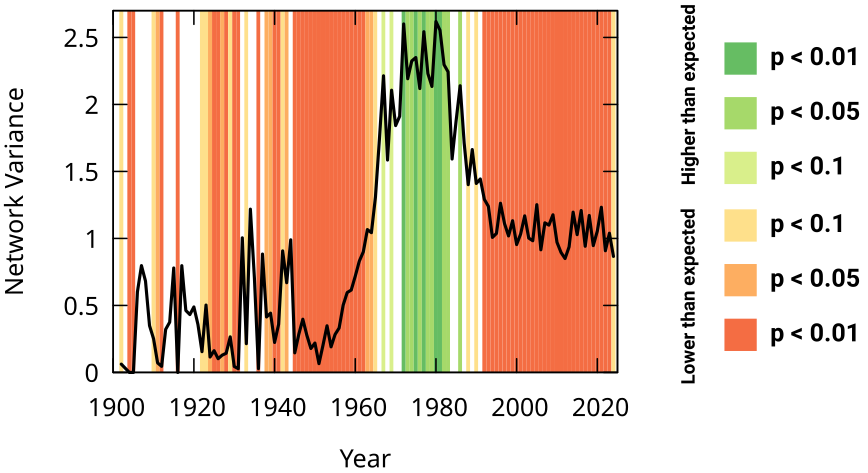
Things start getting interesting when we look at the differences. For instance, by using network variance, we can quantify how much a year was innovative, by looking at how dispersed across the network the bands releasing records that year are (meaning the releases come from unrelated bands). We can control the amount of music produced, so that we know we’re not just looking at a lot of music, but specifically at a diverse body of music. The figure above shows that Denmark had its peak diversification during the 1980s and 1990s, while Italy was innovative earlier, in the 1970-1980 period.
Other differences include how the two music industries relate to different genres. Some genres show a low degree of specialization — meaning many unrelated bands have played them — in either Italy or Denmark, but not both. For instance, a diverse set of bands had tried to make beat music in Italy at its heyday, but not in Denmark. On the other hand, pop rock crops up across many unrelated Danish bands, not systematically, but this is not true in Italy. Various metal genres are also quite central in Denmark, but marginal in Italy.

The cool thing about this exercise is that, by using a consistent convention in making the dataset, the two networks can be merged. Artists who contributed to both Italian and Danish bands can create links across the countries. The global structure is what you see in the above figure. This significantly changes the centrality calculation. Rather than looking at the most important bands within a country, we are now looking at those bands that tie together two different countries.
Here are three examples:
- Temperance: this Italian melodic power metal band is central because their records are produced by Jacob Hansen, a key figure in Danish rock / heavy metal;
- Robertino: an Italian singer who was noticed at age 10 by Danish TV producer Volmer Sørensen, who launched his career;
- Alex Puddu: an Italian funk artist born in Rome, but who relocated in Copenhagen at age 20*.
This has been fun, but, if you know me, you know that I don’t know when it’s time to quit. Of course the next step is to crank this up to eleven. Are the commonalities we see between Denmark and Italy just a coincidence? What if we add a third country? What if we add thirty? You’ll have to stay tuned, as I’m working on a paper to conclude this trilogy.
* To make the figure above, we used the country of origin to decide the node’s color. Alex Puddu was the one case we couldn’t quite figure out. So Lisandro and Daniel resolved to do the only logical thing, and just wrote Alex himself. He was very kind in answering, with details that would likely be appreciated by my friend Max Schich, as in the end even Alex couldn’t call himself either Italian or Danish. In the end, I flipped a coin 🙂